

Jury Selection Software
The difference between collecting information—and truly controlling voir dire
Voir Dire Is Not Slow. It Only Feels That Way—Until It Isn’t
At the start, voir dire feels manageable. You ask a question. A few hands go up. You jot down notes. You move to the next topic.
But within minutes, the pace accelerates. More hands go up. More jurors speak. More stories emerge. More reactions matter. Suddenly, you are no longer just questioning a jury panel—you are managing a real-time stream of information that can affect the direction of the entire trial.
The truth is simple: voir dire is not just a questioning process. It is an information management process happening at high speed. And most lawyers are still using tools that were not built for that reality.
The Cost of Missing Even One Juror Response
What happens when you miss a juror response?
At first, it may seem minor. One missed answer. One unclear note. One uncertain attribution. But the consequences compound quickly.
You may lose the ability to connect that response to the correct juror. You may miss how it fits with other answers across the panel. You may be unable to confidently revisit it later. And most importantly, you may begin to wonder what else you missed.
That uncertainty quietly erodes confidence during one of the most important phases of trial.
The Real Problem Is Not Effort—It Is Structure
Trial lawyers are not failing because they lack effort. They are failing because traditional tools do not match the speed and complexity of modern voir dire.
Legal pads, handwritten seating charts, scattered notes, sticky tabs, and memory under pressure all create the same problem: they require you to reconstruct information after the fact.
But voir dire does not wait for reconstruction. It happens now. Decisions are made now. Impressions form now. Answers matter now.
That is why the lawyer who has the best system for capturing and organizing information has a major advantage.
What Changes When You Never Miss a Response
Now imagine a different experience.
Every hand raise is captured. Every response is tied to the correct juror. Every note is organized immediately. Every member of your team can work from the same information.
You are no longer trying to keep up with voir dire. You are conducting it with control.
That is the difference between ordinary note-taking and a system built specifically for jury selection.
Honey Juror: The Best Way to Conduct Voir Dire
Honey Juror was built for trial lawyers who understand that voir dire is too important to manage with scattered notes and guesswork.
Honey Juror does not tell you what decision to make. It does not replace your judgment. Instead, it gives you a better way to conduct voir dire by helping your team capture, organize, and use the information that jurors provide in real time.
When the information is complete and organized, your judgment becomes sharper. Your team becomes more effective. Your focus stays where it belongs: on the jury.
Capture Every Hand Raise, Every Answer, Every Detail
One of the first things to break down in traditional voir dire is hand-raise tracking. You ask a question. Multiple jurors raise their hands. Someone nods. Another juror begins speaking. Another hand goes up in the back row.
You are forced to choose between looking down to write and looking up to engage.
Honey Juror helps solve that problem. Your team can track hand raises, record responses, and attach notes to the correct juror as the conversation unfolds.
No guessing later. No trying to remember who raised a hand. No frantic reconstruction after court breaks.
The information is captured where it belongs, when it happens.
Know Exactly Who Said What
One of the most damaging questions after voir dire is: “Who said that?”
If you have the statement but cannot confidently tie it to the right juror, the value of the information drops. A strong note becomes an uncertain note. A useful answer becomes a question mark.
Honey Juror keeps juror information tied to the correct person. Each juror can have notes, reactions, ratings, and details organized in one place. That means you are not just collecting information—you are preserving context.
Context is what makes the information usable.
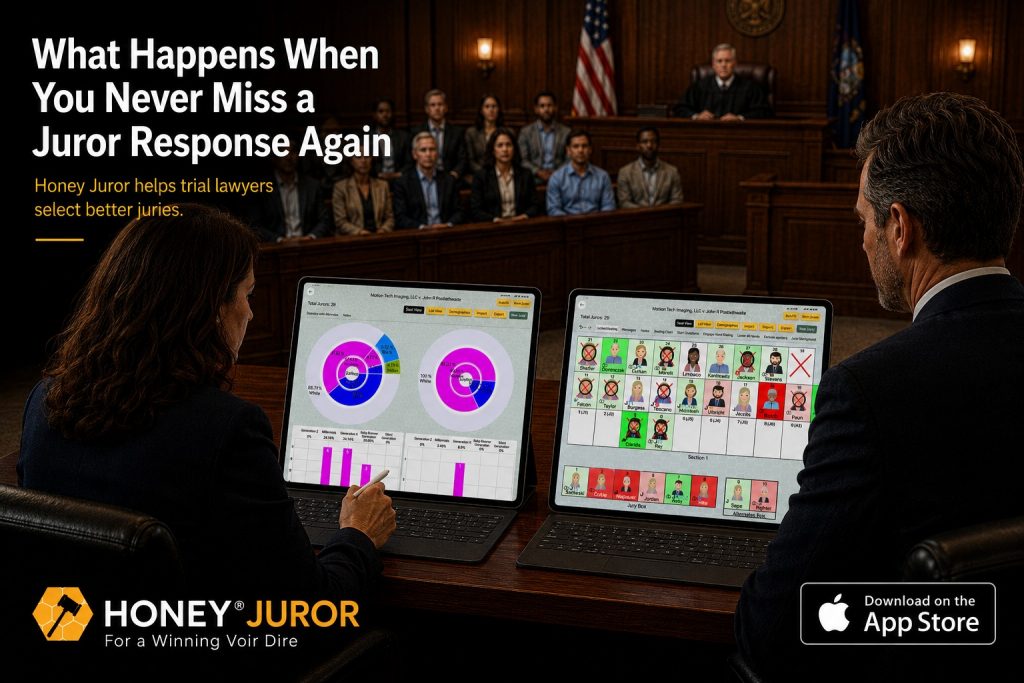
See the Jury Clearly With Digital Seating Charts
Trial lawyers often rely on memory to maintain a mental map of the panel. But mental maps break down under pressure.
Honey Juror gives you a clearer way to view and manage the panel through digital seating charts. Instead of trying to remember where someone is sitting or flipping through paper diagrams, you can connect information to juror position and see the panel as a whole.
That visual structure matters. It helps you understand not only what was said, but where it came from and how it fits across the jury panel.
Turn Your Trial Team Into a Coordinated System
Voir dire is rarely a solo effort. Co-counsel, paralegals, assistants, consultants, and spotters may all be watching and listening. But without a shared system, each person captures separate pieces of the puzzle.
That creates duplicate work, missed details, and confusion.
Honey Juror gives the team a more coordinated way to work together. Notes can be organized in one system. Observations can be captured in real time. The lawyer conducting voir dire can stay focused on the panel while the team helps collect and organize key information.
That is how voir dire should work.
Use the Information You Worked So Hard to Collect
The biggest problem with traditional voir dire notes is not that lawyers fail to write things down. The problem is that much of what gets written down is never fully used.
Why? Because the notes are too scattered, too messy, too hard to search, or too disconnected from the correct juror.
Honey Juror changes the value of the information by making it usable. When responses, hand raises, seating charts, notes, and team observations are organized, you can review key details quickly and act with more confidence.
You are no longer working from fragments. You are working from a structured record.
This Is What Control Looks Like During Voir Dire
Without a system, voir dire can feel reactive. You are trying to ask questions, listen carefully, capture notes, track hands, watch body language, coordinate your team, and prepare for decisions—all at the same time.
With Honey Juror, the process becomes more controlled.
You can stay engaged with the jury. Your team can capture information. Your notes can remain organized. Your seating chart can stay current. Your information can be available when you need it.
That is not just convenience. That is trial efficiency.
The Best Way to Conduct Voir Dire Today
The practice of law continues to evolve. Trial lawyers are expected to manage more information, move faster, and make decisions under tighter pressure. Voir dire is no exception.
Modern voir dire requires a modern system.
Honey Juror is the best way to conduct voir dire because it is built around the real courtroom problem: information comes fast, and the lawyer must be able to keep it organized, accurate, and usable.
When you never miss a juror response again, your whole process improves.
Never Miss a Juror Response Again
In voir dire, success is not just about the questions you ask. It is about what you capture, what you organize, and what you can use when it matters.
Honey Juror gives trial lawyers and their teams a better way to manage the process. It helps reduce chaos, improve organization, coordinate the team, and preserve the information needed to conduct voir dire with confidence.
The best trial lawyers do not rely on luck during voir dire. They rely on systems.
And when you never miss a juror response again, you are no longer trying to keep up.
You are leading the process.
Ready to Conduct Voir Dire With More Control?
Learn more about Honey Juror, the jury selection app built to help trial lawyers capture voir dire notes, track juror responses, build seating charts, and coordinate as a team in real time.
If you are ready to use Honey Juror in your next trial, download Honey Juror from the Apple App Store.
Need setup help? Review the Honey Law guide for installing Honey Juror on your Apple device.
For broader context on why voir dire requires preparation from the beginning of the case, see this American Bar Association article on voir dire and the modern jury panel.
